İstenen sayfanın yerel versiyonuna yönlendirildiniz
Titratörler

Titratörler

Potansiyometrik veya termometrik titrasyonlar için manuel ve tam otomatik titratörler, titrasyon aksesuarları ve titrasyon yazılımı.

Gereksinimleriniz ne olursa olsun - sizin için en doğru Titratör çözümünü sunabiliriz

Titratör portföyümüz, potansiyometrik ve termometrik titrasyon için uygun fiyatlı, kompakt ve bağımsız seçeneklerin yanı sıra modern ve tam otomatik sistemler içermektedir. Aramanızı daraltmak ve sizin için mükemmel titratörü bulmak için filtreleri kullanın. Volumetrik veya kulometrik Karl Fischer titratörleri mi arıyorsunuz? Karl Fischer titratörlerimize gidin 

Titrasyon için uygulamalara göz atın

Güvenilir ve doğru ölçümler  Titratörünüz için bileşenler

Neden Metrohm titratörleri? – Küresel pazar lideriyiz

1943 yılında kurulmuş olan Metrohm, titrasyon analizleri için son teknoloji cihaz ve çözümlerin dünya lideri sağlayıcısı haline gelmiştir.

  • Potansiyometrik titrasyon, volumetrik ve kulometrik Karl Fischer titrasyonu veya proses analizi için aksesuarlar ve yazılımlar dahil olmak üzere kompakt tezgah üstü çözümlerden modüler ototitratör sistemlerine kadar eksiksiz titratör yelpazesini veya proses analizini tek bir tedarikçiden edinin.
  • İsviçre yapımı kaliteye güvenin.
  • Hizmet ve uygulama uzmanlarımızın yerel desteği ile 80'den fazla ülkedeki küresel varlığımızdan yararlanın.

Uygulama uzmanlarımız tarafından yazılan 450'den fazla titrasyon uygulama notu okunmayı bekliyor:

Uygulama Bulucuya gidin

Karl Fischer titrasyonu ve proses analizine yönelik çözümlerimize gidin:

Metrohm Karl Fischer titratörleri

Metrohm titrasyon proses analizörü

Titratör – SSS leri

Titratörler, bir numunede çözünmüş bir maddenin (yani analitin) konsantrasyonunu belirlemek için kullanılmaktadır. Bilinen bir hacimde bir reaktif (titrant) manuel veya otomatik olarak kademeli şekilde eklenmekte ve kimyasal reaksiyon izlenmektedir. 

Titratörlerin adım adım çalışma şekli aşağıda sıralanmaktadır:

  1. Numune ilavesi: Numune, homojenliği sağlamak için genellikle bir karıştırıcı ile bir kaba eklenir.
  2. Titrant ilavesi: Titrant, kontrollü hacimlerde manuel veya otomatik olarak eklenir.
  3. Ölçüm ve izleme: Sensörler reaksiyonu sürekli olarak izler. Titratör, eşdeğerlik noktasını tespit etmek için çözelti özelliklerindeki değişiklikleri (ör. voltaj, renk, iletkenlik) takip eder.
  4. Dönüm noktası tespiti: Dönüm noktası, reaksiyonun tamamlandığı andır.
  5. Sonuç hesaplama ve raporlama: Titratör, kullanılan titrant hacmine göre analitin konsantrasyonunu hesaplar ve dijital bir rapor oluşturur.


Gerçekleştirdiğiniz titrasyonun türüne bağlı olarak reaksiyonu izlemek için çeşitli sensörler mevcuttur. Metrohm, fotometrik, redoks, çökeltme, kompleksometrik, yüzey aktif madde, sulu asit-baz ve susuz asit-baz titrasyonu için sensörler sunmaktadır.

Titrasyon hakkında daha fazla bilgi edinmek için Webinar Merkezimize ve blog makalelerimize göz atın:

Webinar: Titrasyonun temelleri

Blog makalesi: Titrasyonun tanımı ve temel ilkeleri

Blog makalesi: Titrasyonda elektrotlar için en iyi uygulama

An automatic titrator is a laboratory instrument that performs titration procedures automatically, including sample and titrant addition, endpoint detection, and results calculation. Auto titrators have many advantages over manual titrators, such as faster analysis, reproducible measurements, and more.

Learn more about the fully automatic titrator from Metrohm:

Go to OMNIS titrators

Learn more about automatic titration and the advantages over manual titration in our blog:

Blog: Save money by using automated titration systems

Blog: Why consider automation – even for simple titrations

Titration is one of the oldest analytical techniques and is usually performed manually. However, manual titration presents many challenges. An autotitrator automates the titration process, delivering faster, more accurate, and safer results compared to manual titration. The video summarizes the 5 top reasons to switch from manual to automated titration.

  1. Easier preparation of the buret: An autotitrator fills the buret automatically.
  2. Step-by-step guidance: An autotitrator automatically transfers the sample size from the balance to the software or instrument, adjusts the stirring speed, and more.
  3. More reliable and reproducible endpoint evaluation: Automatic titrators ensure objective endpoint detection.
  4. Complete documentation according to GxP: Autotitrators ensure compliance with FDA CFR Part 11 and EudraLex Vol. 4, Annex 11.
  5. Safer handling of chemicals: Autotitrators reduce the exposure to hazardous chemicals.

In summary, the main benefits of an autotitrator are:

  • Speed and throughput: Faster analysis and higher sample throughput
  • Accuracy and reproducibility: Automated dosing and endpoint detection minimize human error
  • Efficiency: Frees lab personnel from repetitive tasks
  • Safety: Minimizes chemical exposure
  • Data management: Digital reports and integration with LIMS/ERP systems
  • Scalability: Modular accessories and automation options adapt to changing workloads

Choosing the right titrator depends on your sample type, analytical goals, and lab environment. Here are the key factors to consider:

Factors Tips
Type of titration
  • Potentiometric titration: Ideal for acid-base, redox, complexometric, and precipitation reactions.
  • Photometric: Suitable for colored, opaque, or non-aqueous samples.
  • Thermometric titration: Best for samples where traditional sensors may not work.
  • Conductometric titration: Useful for reactions involving ionic changes.
Sample characteristics
  • Consider whether your samples are liquids, solids, slurries, or gases.
  • Some titrators offer accessories like homogenizers or sample preparation modules to handle complex matrices.
Throughput & automation
  • For high sample volumes, look for titrators with autosamplers or robotic automation (e.g., Metrohm’s OMNIS Sample Robot).
  • Parallel titration capabilities can significantly boost lab efficiency.
Accuracy & reliability
  • Choose systems with precise dosing, sensitive sensors, and robust endpoint detection.
  • Look for instruments that support method validation and reproducibility.
Compliance & data management
  • Ensure compatibility with GLP/GMP, 21 CFR Part 11, and other regulatory standards.
  • Check for integration with LIMS, ERP, or ELN systems for traceability and audit readiness.
Modularity & scalability
  • Opt for a platform that grows with your lab. Metrohm’s OMNIS titrators allow expansion with additional modules and titration modes.
Support & service
  • Consider availability of training, application support, and service contracts.
  • Ask about software updates, warranty coverage, and repair turnaround times.

Our titration experts are happy to assist you with your questions:

Contact us

The most common indication methods for automated titrations are potentiometric and photometric endpoint (EP) determination.

In potentiometric EP determination, the difference in potential is measured: The concentration-dependent potential of a solution is measured using an indicator electrode against a reference potential, which is measured using a reference electrode. Combined sensors including both indicator and reference electrode are also available.

In photometric EP determination, a photometric sensor, such as the Optrode from Metrohm, is used to determine the change in intensity at a particular wavelength of a light beam passing through a solution.

Another kind of titration that is less well known is thermometric titration. Thermometric EP determination relies on detecting temperature changes during the titration reaction. A highly sensitive temperature sensor monitors the solution, and the endpoint is identified by a sudden change in temperature, which occurs due to the exothermic or endothermic nature of the reaction. This method is especially useful for titrations where no suitable electrode or photometric indicator is available.

Learn more about potentiometric, photometric, and thermometric endpoint determination in our blog:

Blog: Recognition of endpoints (EP)

Blog: Thermometric titration – the missing piece of the puzzle

Webinar: Thermometric titration

Fully automated titration systems increase efficiency, accuracy, safety, and reliability of your titrations. Automated systems are ideal for high-throughput labs, routine analysis, and when minimizing manual labor is critical.

The OMNIS Sample Robot from Metrohm, for instance, allows you to fully automate the analysis of up to 175 samples.

Learn more about automated titration:

Webinar: The benefits of automating your titration applications

High-throughput labs not only need instruments with a large sample capacity, they also look for a system which offers flexibility and modularity to adapt to changing applications or peaks in workload.

OMNIS titrators and the OMNIS Sample Robot form the perfect titration system for high-throughput laboratories. OMNIS offers parallel titration, modular expansion, and automated sample handling. Watch the video to learn more.

Yes, entry-level Metrohm titrators (i.e., Eco Titrators) deliver reliable accuracy when paired with proper electrodes and validated methods.

The accuracy of titrations does not only depend on the instrument, it is the sum of several factors that contribute to it:

  • Choice of a suitable electrode or indication method
  • Choice of a suitable cylinder volume
  • Choice of a suitable titration mode
  • Accuracy of sample size (weighing/pipetting)
  • Homogenization of the sample
  • Electrode cleaning and maintenance
  • Burette maintenance
  • Other factors, depending on the specific titration method


An overview on how to get correct and accurate titration results can be found here:

Blog: How to avoid titration errors in your lab

Blog: Validation of  titration methods

Webinar: Avoid titration mistakes through best practice sensor handling

Webinar: Troubleshooting titration: essential know-how for quality results

Metrohm’s Ti-Touch and OMNIS titrators offer audit trails, user management, and secure data handling for full regulatory compliance to 21 CFR Part 11.

Stand-alone titrators (without PC software): Ti-Touch

Software-controlled titrators: OMNIS

Validating a titration method ensures that the procedure delivers accurate, reproducible, and reliable results – especially when transitioning from manual to automated titration. Metrohm recommends following the validation framework outlined in USP General Chapter <1225> Validation of Compendial Procedures and ICH Guidance Q2(R1) Validation of Analytical Procedures: Text and Methodology, which includes the following key steps:

  • Perform standardization of the titrant using a primary standard or a pre-standardized solution
  • Assess the accuracy and precision of the titration results by performing reference measurements
  • Verify the linearity of your results, i.e., that the titration results are proportional to the analyte concentration across the expected range
  • Demonstrate specificity, i.e., that the method can accurately measure the analyte without interference from impurities, excipients, or degradation products.

Find more information:

Blog: Validation of titration methods

White paper: Recommendations for titration methods validation


Modern titration systems offer various data formats for transferring titration data to an external software (LIMS / ERP / ELN). The most common formats are:

  • PC/LIMS report
  • XML report
  • PDF
  • CSV

Any Metrohm titrator offers at least one of these options, either by transferring the corresponding data in a corresponding file to a USB memory stick or directly to a computer/network directory.

The OMNIS Software offers a convenient and secure data exchange between OMNIS and any 3rd party software (e.g., LIMS, ERP, ELN) by direct transfer based on the REST software architecture.

Titrasyon hakkında daha fazla bilgi edinmek ister misiniz?

Ücretsiz kopyasını indirmek için tıklayın

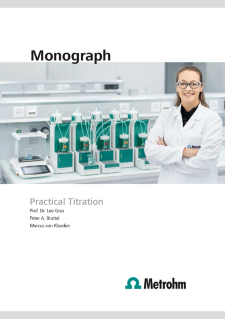
Bu ücretsiz monograf yayını, "Pratik titrasyon", titrasyon reaksiyonlarını, indikasyon yöntemlerini, elektrotları ve titrantları açıklayan titrasyon teorisini kapsamaktadır. Pratik kısımda asit-baz, çökeltme, redoks, kompleksometrik ve kelometrik titrasyonlar tartışılmaktadır.