Byli jste přesměrováni na vaši místní verzi požadované stránky
Iontová chromatografie

Iontová chromatografie

Metrohm IC: Robustní, snadno použitelné iontové chromatografy pro stanovení aniontů, kationtů a polárních látek. V naší nabídce naleznete iontové chromatografy, separační kolony i řešení pro automatizaci a přípravu vzorků. Prohlédněte si systémy pro vysokotlakou iontovou chromatografii (HPIC), které jsou ideální jak pro rutinní laboratorní analýzy atak i pro výzkumné a vzdělávací aplikace.

Whatever your requirements – we have the right Ion Chromatograph for you

Our range of ion chromatography (IC) instruments covers cost-effective, compact, and stand-alone options for routine analysis as well as modern, fully automated, and hyphenated systems for advanced applications. Our IC portfolio includes detectors, columns, sample preparation and automation solutions. Use the filters to refine your search and find the perfect ion chromatography system for you.

Find applications for Ion chromatography

Robust and reliable IC – Components for your ion chromatography

Why Metrohm IC instruments? – More than 30 years of experience

The first ion chromatograph was added to Metrohm's portfolio of analytical chemical instrumentation in 1987. Since then, Metrohm has been developing and manufacturing state-of-the-art IC solutions, from simple setups for academic laboratories to fully automated, high-performance IC systems and hyphenated techniques such as IC-MS or IC-ICP/MS as well as the heart of ion chromatography itself: the separation columns.

Learn more about Metrohm IC in our blog:

Blog series: History of Metrohm IC

Ion chromatography instruments – FAQs

Ion chromatographs are analytical instruments used to separate and quantify ions in liquid samples. The following steps are performed by an ion chromatography instrument from Metrohm (see video):

  1. Pre-rinsing: The eluent, or mobile phase, passes through the IC system. The eluent is continuously pumped through the separation column. It consists of an aqueous solution with various ions that compete with the sample ions for binding sites on the resin in the separation column. The eluent composition is carefully optimized to achieve the best separation of target ions.
  2. Sample preparation (optional): Typically, sample preparation techniques are used before injecting the sample into the sample loop. Sample preparation leads to more acurate and reliable results and can prevent damages to the separation column and IC system. Sample preparation techniques include filtration, dilution, and extraction.
  3. Injection valve: The position of the injection valve switches to FILL and the sample enters the sample loop.
  4. Sample injection: The injection valve injects the sample towards the separation column.
  5. Sample separation: The sample flows through a separation column, or stationary phase, filled with an ion exchange resin. This resin contains charged functional groups that selectively interact with specific ions. The choice of resin depends on the target ions to be analyzed.
  6. Elution and detection: The retained ions are gradually released from the resin as the sample progresses through the column. The retention time for each ion depends on its affinity for the resin and the eluent conditions. The eluent, containing the separated ions, reaches a detector within the ion chromatograph. Different types of detectors, such as conductivity detectors, UV/Vis detectors, or mass spectrometers, can be used. The detector measures the concentration of specific ions eluting from the column.
  7. Data analysis: An ion chromatography software records and processes the detector output. The resulting data is used to generate chromatograms that display the concentration of target ions over time.

Metrohm IC instruments can be used for environmental, pharmaceutical, as well as water and wastewater analysis, in the food and beverage, chemical, and energy production industry as well as in research and academia.

The separation columns cover the most common separation mechanisms, i.e., ion exchange, ion exclusion, and ion pair formation, and disciplines in ion chromatography. The application field includes:

  • anions and cations with or without suppression
  • transition metals
  • carbohydrates
  • organic acids
  • amines
  • amino acids

We share over 1,700 downloadable application documents in the Application Finder. You can find more information in our blog, webinars, or in the Product Help Center.

Local experts can also be contacted for troubleshooting and to solve complex analytical problems either on-site or at one of their global application laboratories.

Contact us

Yes, monitoring PFAS (per- and polyfluoroalkyl substances) is a straight-forward and widely used procedure for ion chromatography in combination with pyrohydrolytic combustion, known as Combustion Ion Chromatography (CIC). CIC enables the determination of total and organic fluorine in a wide variety of samples, such as wastewater or fabric.

CIC can be used for PFAS screening via AOF (Adsorbable Organic Fluorine). The CIC method involves adsorption of organofluorines onto activated carbon, combustion at high temperature (1050 °C) to convert organically bound fluorine into hydrogen fluoride, and absorption of the combustion gases (HF) in water.

IC is used to quantify fluoride ions, indirectly indicating PFAS presence. This approach is standardized (e.g., U.S. EPA Method 1621, DIN 38409-59, ISO/DIS 18127) and suitable for non-targeted screening of PFAS in aqueous samples.

Application Note: Monitoring PFASs in water sources with CIC

White Paper: Adsorbable organic fluorine (AOF) for screening of PFAS in waters

Using ion chromatography coupled to tandem mass spectrometry is a reliable and validated method (DIN 38407-53) to quantify short-chain and ultrashort-chain PFAS, such as trifluoroacetic acid (TFA), and support environmental monitoring.

Short-chain and ultrashort-chain PFAS (S and US-PFAS) are breakdown and substitute products of long-chain PFAS with fewer carbon atoms. Due to their high water solubility and persistence, ultrashort- and short-chain PFAS can easily migrate into drinking water sources. TFA is a prominent example of an ultrashort-chain PFAS. Its small molecular size makes it highly mobile and difficult to remove through conventional water treatment.

Learn more:

Application Note: IC-MS/MS analysis of trifluoroacetic acid according to DIN 38407-53

Yes, ion chromatography has become widely accepted by the pharma industry and regulatory bodies for an expanded range of applications, such as water quality and chemical analysis. In recent years, IC has qualified to analyze pharmaceuticals.

The United States Pharmacopeia-National Formulary (USP-NF), the driving standardization body for (bio)pharmaceutical products, increased IC's potential during their modernization approaches, establishing it as an appropriate and valid technique in their compendial General Chapters (e.g., USP General Chapter <1065> Ion Chromatography), assays, and impurity tests.

Blog: Ion chromatography for the pharmaceutical industry

Blog: Applying USP validated methods for separation column equivalency

White Paper: When HPLC fails: IC in food, water, and pharmaceutical analysis

Flyer: Bring your USP methods up to date (8.000.5436, PDF, 900 KB)


Application-specific criteria are the most important factors for your decision-making. Keep the following in mind:

  • analytes to be measured
  • sample matrix
  • detection method
  • detection sensitivity and range
  • selectivity and resolution
  • automation and sample throughput
  • eluent management
  • cost of consumables
  • software updates
  • compliance with international and national standards

Our IC experts are happy to assist you with any questions you have:

Contact us

It depends on the instrument. For example, the 940 Professional IC Vario systems from Metrohm are upgradable at any time. These systems are designed with a modular and highly flexible architecture, which allows users to adapt them to evolving analytical requirements. Add as needed, for instance:

Such modularity ensures that the system remains future-proof and can be upgraded to meet future demands.

Brochure: 940 Professional IC Vario and 942 Extension Module Vario (8.940.5003, PDF, 2.3 MB)

Yes, Metrohm IC systems can be used for applications compliant with EPA 300.0, EPA 300.1 parts A and B, or ISO 14911.

With the 930 Compact IC Flex, equipped with the 948 Continuous IC Module for automatic hydroxide eluent generation, an MiPT (Metrohm intelligent Partial Loop Injection Technique) setup for single-standard calibration, and the high-capacity Metrosep A Supp 21 column, Metrohm provides a reliable and economic setup to analyze water samples according to EPA Method 300.0 as well as EPA 300.1 Parts A and B in a single IC run.

Application Note: Drinking water quality by EPA 300.1

White Paper: Determination of anions in tap water in accordance with US EPA Method 300

Utilizing a Metrosep C 4 – 150/4.0 or a Metrosep C6 – 150/4.0 column in conjunction with a 940 Professional IC Vario allows for compliance with the requirements specified in ISO 14911. Furthermore, incorporating an 858 Professional Sample Processor and Metrohm Inline Sample Preparation options can enhance the speed of analysis while reducing manual workload.

Application Note: Cations in drinking water using Metrosep C 4 - 150/4.0 column according to ISO 14911

The ideal solution for high-throughput labs is a reliable, accurate IC system consisting of the following components:


Blog: Save time and money with Metrohm Inline Sample Preparation solutions

Blog: Boost your environmental analysis with Metrohm automated ion chromatography

Yes, for Metrohm IC instruments, eluent generation can be automated.

The 948 Continuous IC Module, CEP is the automated solution for the production of hydroxide eluents. With a direct connection to a water purification system (e.g., ELGA® PURELAB® flex 5/6), the IC can be operated unattended 24/7.

The 941 Eluent Production Module enables the production of eluents of any composition and concentration such as salts or diluted acids. Thanks to Inline Dilution and the patented Dosino technology, up to four eluents can be produced in parallel with just one module. Combined with a direct connection to a water purification system (e.g., ELGA® PURELAB® flex 3+), the IC can be operated unattended 24/7.

Webinar: Automatic hydroxide eluent preparation: Overcoming inefficiencies in anion analysis

Yes, IC can perform gradient elution. Metrohm offers several systems to support gradient elution:

  • high-pressure gradient
  • low-pressure gradient
  • Dose-in gradient
  • hydroxide gradient by eluent generation

Eluents are mixed using two or more high-pressure pumps. The Metrohm high-pressure gradient (HPG) system (e.g., 940 Professional IC Vario TWO/SeS/PP with IC Conductivity Detector and a 942 Extension Module Vario HPG for 3 eluents) uses three high-pressure pumps to mix eluents under pressure, allowing for various gradient profiles such as linear, stepwise, concave, and convex.

This system is particularly suitable for complex separations, including anions, cations, sugars, amino acids, and other polar substances.

Application Note: Biogenic amines besides other cations in red wine applying a high-pressure gradient

Application Note: Quality labels for novel foods

Low-pressure gradients are used in ion chromatography to improve peak separation for complex applications and matrices.

Typical area of application:

  • Gradient applications for anion or cation determinations with sequential suppression

A single high-pressure pump aspirates eluents through a mixing capillary, with a low-pressure valve controlling the mixing ratio. The setup is simple, solvent-stable, and it supports a wide range of gradient profiles.

A compact and cost-effective example is the low-pressure (LPG) system from Metrohm  (e.g., 940 Professional IC Vario ONE/SeS/PP/LPG).

Brochure: Gradients in ion chromatography (8.000.5131, PDF, 2.2 MB)

Application Note: Thiosulfate, thiocyanate and perchlorate in addition to standard anions using a low-pressure gradient

A Dose-in gradient is highly flexible and can be retrofitted to any Metrohm IC system (e.g., the combination of 940 Professional IC Vario and 800 Dosino for Dose-in Gradients).

It works in the low-pressure range using a high-pressure pump and a 6-port adapter to dose up to five eluents. This system supports both linear and stepwise gradients and is compatible with organic solvents. It is easy to install and operate, making it a practical choice for laboratories requiring adaptable and straightforward gradient capabilities.

Application Note: Metrohm IC Driver for OpenLab CDS: Anions with Dose-in Gradient and Dosino Regeneration

Application Note: Determination of sugars and sugar alcohols using pulsed amperometric detection and Dose-in Gradient

The hydroxide gradient by eluent generation creates hydroxide eluents electrochemically from a concentrated stock solution. This is done with the help of the eluent generator (948 Continuous IC Module, CEP) together with a supply of  ultrapure water, e.g., by a water purification system. The eluent and gradient generation process happens on-demand and inline, and the generated eluent is then delivered by a high-pressure pump. It has a higher precision and less noise than a high-pressure gradient.

Application Note: Water quality testing with EPA 300.1

Application Note: Trace haloacetic acids, dalapon, and bromate measurement in drinking water

The replacement as well as service intervals highly depend on the samples that are measured. Usually, regular maintenance can help to improve the lifetime of the suppressor and the column.

Further tips:

  • Use of a pre-column – it protects the column and can be exchanged regularly, while the analytical column can sill be used.
  • Use automated and integrated sample preparation, such as Metrohm Inline Sample Preparation techniques, to protect the whole system and increase its lifetime.


Learn more about the maintenance intervals for IC instruments

Yes, filtering samples for ion chromatography (IC) is generally recommended and often necessary.

Why do IC samples need to be filtered?

  • Protecting the column and system: IC columns are sensitive and expensive. Particulates in unfiltered samples can clog the column or damage the resin, leading to poor performance and costly replacements.
  • Preventing flow path blockages: Particulates can obstruct tubing, valves, and injectors, causing pressure spikes, inconsistent flow, or system failures.
  • Improving detection quality: Suspended solids may interfere with detection or cause baseline noise, affecting quantification accuracy.
  • Ensuring consistent pressure and flow: A clean sample helps maintain stable system conditions, which is critical for reproducible results.

How are IC samples typically filtered?

  • Manual filtration: Using syringe filters (typically 0.45 µm or 0.2 µm pore size) or centrifugation. While effective, these methods are time-consuming and require additional materials and labor.
  • Inline Ultrafiltration (UF) technique from Metrohm: Inline and fully automated filtration. This system can be added to any Metrohm IC setup, provided the autosampler is equipped with a peristaltic pump.


Learn more about Inline Ultrafiltration in our blog:

Blog: Protecting IC systems with Metrohm Inline Ultrafiltration and Inline Dialysis

Yes, you can run both anions and cations on the same IC system. However, you require an anion exchange column for anion separation and a cation exchange column for cation separation.

If you use a single-channel ion chromatograph, such as 930 Compact IC Flex SeS/PP, you can run anions and cations consecutively. The 930 Compact IC Flex SeS/PP is the intelligent Compact IC instrument with sequential suppression and a peristaltic pump for suppressor regeneration. The instrument can be used with any separation and detection methods.

Typical areas of application include:

  • Anion or cation determinations with sequential suppression and conductivity detection

However, single-channel ion chromatographs need to be cleaned thoroughly in between the measurements to avoid crosscontamination. Using a dual-channel system is the better solution, as you can run anions and cations in parallel.

Metrohm offers various ProfIC Vario systems with two analysis channels, enabling fully automatic determination of anions and cations, both in parallel and also completely independently of one another as a time-saving feature.

Typical areas of application include:

  • Universal anion and cation analysis
  • Routine analysis with large numbers of samples without additional sample preparation


Application Note: Metrohm IC Driver for OpenLab CDS – OpenLab controlled dual channel cation and anion analysis with automated Inline Eluent Production

Application Note: Metrohm IC Driver for OpenLab CDS: Anion and cation analysis in a soft drink

Application Note: Parallel anion (and cation) analysis applying the Metrohm IC Driver 2.0 for Empower

Application Note: Tap water analysis for anions using Metrohm intelligent Partial Loop Technique (MiPT)

To analyse anions and cations with suppressed conductivity detection, you need an IC system that is equipped with an anion and a cation separation column, two conductivity detectors, and the capability for anion suppression.

Metrohm offers various systems with sequential suppressionconductivity detection, and two analysis channels, enabling fully automatic determination of anions and cations, both in parallel and also completely independently of one another.

Typical areas of application include:

  • Universal anion and cation analysis
  • Routine analysis with large numbers of samples without additional sample preparation

The modular system is upgradable. In case you need cation suppression, an extension module can be added to the system. The 942 Extension Module Vario SeS/PP is an extension module for the Professional IC Vario line of instruments. It allows the integration of a complete sequential suppression with a peristaltic pump for suppressor regeneration.

Typical applications include:

  • Sequential suppression for an additional analysis channel


Application Note: Metrohm IC Driver for OpenLab CDS – OpenLab controlled dual channel cation and anion analysis with automated Inline Eluent Production

Application Note: Metrohm IC Driver for OpenLab CDS: Anion and cation analysis in a soft drink

Application Note: Parallel anion (and cation) analysis applying the Metrohm IC Driver 2.0 for Empower

Application Note: Tap water analysis for anions using Metrohm intelligent Partial Loop Technique (MiPT)

Metrohm IC systems are controlled with our proprietary ion chromatography software MagIC Net. MagIC Net is a simple and intuitive software that controls the components of the intelligent Metrohm ion chromatography systems as well as their peripheral devices for Liquid Handling and automation. MagIC Net meets all FDA and GLP requirements.

In addition, Metrohm IC systems can be fully controlled by OpenLab CDS from Agilent and EmpowerTM from WatersTM. They enable hyphenation of Metrohm IC with single quadrupole mass spectrometers and their operation in a single software. For hyphenation with ICP-MS, Metrohm developed a solution for single-software use of Metrohm IC and Agilent ICP-MS in ICP-MS MassHunter.


Brochure: MagIC Net 4 (8.102.5010, PDF, 1.4 MB)

Brochure: IC Driver for Agilent OpenLab CDS (8.102.5007, PDF, 1 MB)

Brochure: Metrohm meets Empower 3 (8.102.5004, PDF, 213 KB)

Brochure: IC Driver for ICP-MS MassHunter Software (8.000.5496, PDF, 1.25 MB)

Yes, you can use OpenLab CDS to control ion chromatographs from Metrohm. Supported Metrohm IC instruments include:

Additionally, you can control and operate both Metrohm IC and Agilent single quadrupole MS instruments within one software environment (OpenLab CDS), enabling IC-MS hyphenation.

Yes, OpenLab CDS can handle data from both Metrohm IC and Agilent MS instruments together when they are integrated in a hyphenated setup (IC-MS).

Data handling in OpenLab CDS supports synchronized acquisition and processing of data from both instruments. You can view chromatograms and mass spectra in a single interface, perform peak identification and quantification using both IC and MS data, and generate combined reports that include results from both systems.

The integration streamlines workflows for trace analysis, speciation, and complex matrix investigations. It eliminates the need to manually merge data from separate software platforms.

Requirements: You need the Metrohm IC Driver for OpenLab CDS and a compatible version of OpenLab CDS (2.3–2.8) including an Agilent license for non-Agilent Instrument Connection (for CDS 2.4+).

Yes, when Metrohm IC instruments are integrated into OpenLab CDS using the Metrohm IC Driver, the audit trail functionality remains fully supported.

  • All actions involving Metrohm IC instruments (e.g., method changes, data acquisition) are logged in OpenLab’s audit trail.
  • The integration does not interfere with audit trail integrity or regulatory compliance.

Requirements: A non-Agilent Instrument Connection license is required for OpenLab CDS 2.4+.


Brochure: IC Driver for Agilent OpenLab CDS – A perfect combination: Metrohm Ion Chromatography and OpenLab CDS Software (8.102.5007, PDF, 2.2 MB)

Yes, the MagIC Net software is audit-trail capable.

MagIC Net:

  • automatically records all user activities, including the user name, client name, action performed, date, time, and time zone difference (UTC).
  • tracks changes to data, including modifications to methods and results, with version control and mandatory comments for edits.

When 21 CFR Part 11 is activated in MagIC Net, all previous versions of the modified data are stored in the database.

MagIC Net supports 21 CFR Part 11 compliance, which includes audit trail requirements for electronic records and electronic signatures. This ensures traceability, accountability, and data integrity – key requirements for regulated environments like pharmaceutical or food testing labs.

Brochure: MagIC Net – Intelligent Software for Ion Chromatography (8.102.5010, PDF, 1.5 MB)

Webinar: Showcasing advanced functionalities of MagIC Net

Metrohm IC systems are compliant with 21 CFR Part 11 when operated with the software MagIC Net, OpenLab CDS, or EmpowerTM. The compliance governs electronic records and electronic signatures in FDA-regulated environments. Compliance usually includes features like secure user authentication, audit trails, electronic signatures, and data integrity controls.

Learn more about compliance in regulated environments:

Blog: Ensuring and certifying quality and compliance in regulated environments

Yes, measurement data can be exported to LIMS (Laboratory Information Management Systems) via MagIC Net. This is typically done via standardized data formats or direct integration protocols, which are often mentioned in system documentation or specifications.

Learn more about ion chromatography

Download your free copy here

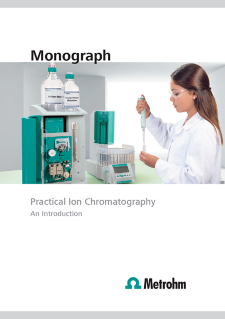
The free monograph "Practical Ion Chromatography" gives an introduction to the theory of ion chromatography covering the basic principles, retention models, eluents, and more. The practical part of the monograph presents different experiments for the determination of anions and cations.