Zostałaś(eś) przekierowany do lokalnej wersji strony
Titratory - sprzęt do miareczkowania

Titratory - sprzęt do miareczkowania

Innowacyjne titratory, systemy do miareczkowania, akcesoria i doświadczenie wiodącego światowego dostawcy rozwiązań do miareczkowania.

Niezależnie jakie masz wymagania– dopasujemy odpowiedni titrator!

Nasza oferta titratorów obejmuje niedrogie, kompaktowe i samodzielne opcje, a także nowoczesne i w pełni zautomatyzowane systemy miareczkujące. Użyj filtrów, aby zawęzić wyszukiwanie i znaleźć idealny automatyczny titrator do Twojego laboratorium.

Wyszukiwanie aplikacji miareczkowych

Wiarygodne i dokładne pomiary analityczne – akcesoria do Twojego titratora automatycznego

Dlaczego titratory Metrohm? – jesteśmy światowym liderem na rynku

Założona w 1943 roku firma Metrohm stała się wiodącym na świecie dostawcą najnowocześniejszych przyrządów i rozwiązań do analiz miareczkowych.

  • Zapoznaj się z pełną gamą titratorów, od kompaktowych rozwiązań laboratoryjnych po modułowe systemy autotitratorów, w tym akcesoria i oprogramowanie do miareczkowania potencjometrycznego, wolumetrycznego i kulometrycznego miareczkowania Karla Fischera lub analizy procesowej od jednego dostawcy.
  • Polegaj na szwajcarskiej jakości
  • Skorzystaj z naszej globalnej obecności w ponad 80 krajach i uzyskaj lokalne wsparcie naszych ekspertów w zakresie usług i aplikacji chemicznych

Przez naszych specjalistów ds. aplikacji zostało przygotowanych ponad 450 not aplikacyjnych na temat miareczkowania!

Przejdź do wyszukiwarki aplikacji

Przejdź do naszych rozwiązań w zakresie miareczkowania Karla Fischera i analizy procesowej:

Titratory Karla Fischera firmy Metrohm

Miareczkowanie w analizie procesowej firmy Metrohm

Titrator – pytania i odpowiedzi

Titrators are used to determine the concentration of a substance (analyte), which is dissolved in a sample. A reagent (titrant) is added gradually in a known volume to the sample until a chemical reaction reaches its endpoint, which is detected by a sensor.

How titrators work step-by-step:

  1. Sample addition: The sample is added to a vessel, often with a stirrer to ensure homogeneity.
  2. Titrant addition: The titrant is added manually or automatically in controlled volumes.
  3. Measurement & monitoring: Sensors continuously monitor the reaction. The titrator tracks changes in solution properties (e.g., voltage, color, conductivity) to detect the equivalence point.
  4. Endpoint detection: The endpoint is the moment when the reaction is complete.
  5. Result calculation & reporting: The titrator calculates the concentration of the analyte based on the volume of titrant used and generates a digital report.


Various sensors are available to monitor the reaction depending on the type of titration you are performing. Metrohm offers sensors for photometric, thermometric, redox, precipitation, complexometric, surfactant, aqueous or non-aqueous acid-base titration.

Check out our Webinar Center and our blog to learn more about titration:

Webinar: Basics of titration

Blog: Titration – definition and principles

Blog: Best practices for electrodes in titration

An automatic titrator is a laboratory instrument that performs titration procedures automatically, including sample and titrant addition, endpoint detection, and results calculation. Auto titrators have many advantages over manual titrators, such as faster analysis, reproducible measurements, and more.

Learn more about the fully automatic titrator from Metrohm:

Go to OMNIS titrators

Learn more about automatic titration and the advantages over manual titration in our blog:

Blog: Save money by using automated titration systems

Blog: Why consider automation – even for simple titrations

Titration is one of the oldest analytical techniques and is usually performed manually. However, manual titration presents many challenges. An autotitrator automates the titration process, delivering faster, more accurate, and safer results compared to manual titration. The video summarizes the 5 top reasons to switch from manual to automated titration.

  1. Easier preparation of the buret: An autotitrator fills the buret automatically.
  2. Step-by-step guidance: An autotitrator automatically transfers the sample size from the balance to the software or instrument, adjusts the stirring speed, and more.
  3. More reliable and reproducible endpoint evaluation: Automatic titrators ensure objective endpoint detection.
  4. Complete documentation according to GxP: Autotitrators ensure compliance with FDA CFR Part 11 and EudraLex Vol. 4, Annex 11.
  5. Safer handling of chemicals: Autotitrators reduce the exposure to hazardous chemicals.

In summary, the main benefits of an autotitrator are:

  • Speed and throughput: Faster analysis and higher sample throughput
  • Accuracy and reproducibility: Automated dosing and endpoint detection minimize human error
  • Efficiency: Frees lab personnel from repetitive tasks
  • Safety: Minimizes chemical exposure
  • Data management: Digital reports and integration with LIMS/ERP systems
  • Scalability: Modular accessories and automation options adapt to changing workloads

Choosing the right titrator depends on your sample type, analytical goals, and lab environment. Here are the key factors to consider:

Factors Tips
Type of titration
  • Potentiometric titration: Ideal for acid-base, redox, complexometric, and precipitation reactions.
  • Photometric: Suitable for colored, opaque, or non-aqueous samples.
  • Thermometric titration: Best for samples where traditional sensors may not work.
  • Conductometric titration: Useful for reactions involving ionic changes.
Sample characteristics
  • Consider whether your samples are liquids, solids, slurries, or gases.
  • Some titrators offer accessories like homogenizers or sample preparation modules to handle complex matrices.
Throughput & automation
  • For high sample volumes, look for titrators with autosamplers or robotic automation (e.g., Metrohm’s OMNIS Sample Robot).
  • Parallel titration capabilities can significantly boost lab efficiency.
Accuracy & reliability
  • Choose systems with precise dosing, sensitive sensors, and robust endpoint detection.
  • Look for instruments that support method validation and reproducibility.
Compliance & data management
  • Ensure compatibility with GLP/GMP, 21 CFR Part 11, and other regulatory standards.
  • Check for integration with LIMS, ERP, or ELN systems for traceability and audit readiness.
Modularity & scalability
  • Opt for a platform that grows with your lab. Metrohm’s OMNIS titrators allow expansion with additional modules and titration modes.
Support & service
  • Consider availability of training, application support, and service contracts.
  • Ask about software updates, warranty coverage, and repair turnaround times.

Our titration experts are happy to assist you with your questions:

Contact us

The most common indication methods for automated titrations are potentiometric and photometric endpoint (EP) determination.

In potentiometric EP determination, the difference in potential is measured: The concentration-dependent potential of a solution is measured using an indicator electrode against a reference potential, which is measured using a reference electrode. Combined sensors including both indicator and reference electrode are also available.

In photometric EP determination, a photometric sensor, such as the Optrode from Metrohm, is used to determine the change in intensity at a particular wavelength of a light beam passing through a solution.

Another kind of titration that is less well known is thermometric titration. Thermometric EP determination relies on detecting temperature changes during the titration reaction. A highly sensitive temperature sensor monitors the solution, and the endpoint is identified by a sudden change in temperature, which occurs due to the exothermic or endothermic nature of the reaction. This method is especially useful for titrations where no suitable electrode or photometric indicator is available.

Learn more about potentiometric, photometric, and thermometric endpoint determination in our blog:

Blog: Recognition of endpoints (EP)

Blog: Thermometric titration – the missing piece of the puzzle

Webinar: Thermometric titration

Fully automated titration systems increase efficiency, accuracy, safety, and reliability of your titrations. Automated systems are ideal for high-throughput labs, routine analysis, and when minimizing manual labor is critical.

The OMNIS Sample Robot from Metrohm, for instance, allows you to fully automate the analysis of up to 175 samples.

Learn more about automated titration:

Webinar: The benefits of automating your titration applications

High-throughput labs not only need instruments with a large sample capacity, they also look for a system which offers flexibility and modularity to adapt to changing applications or peaks in workload.

OMNIS titrators and the OMNIS Sample Robot form the perfect titration system for high-throughput laboratories. OMNIS offers parallel titration, modular expansion, and automated sample handling. Watch the video to learn more.

Yes, entry-level Metrohm titrators (i.e., Eco Titrators) deliver reliable accuracy when paired with proper electrodes and validated methods.

The accuracy of titrations does not only depend on the instrument, it is the sum of several factors that contribute to it:

  • Choice of a suitable electrode or indication method
  • Choice of a suitable cylinder volume
  • Choice of a suitable titration mode
  • Accuracy of sample size (weighing/pipetting)
  • Homogenization of the sample
  • Electrode cleaning and maintenance
  • Burette maintenance
  • Other factors, depending on the specific titration method


An overview on how to get correct and accurate titration results can be found here:

Blog: How to avoid titration errors in your lab

Blog: Validation of  titration methods

Webinar: Avoid titration mistakes through best practice sensor handling

Webinar: Troubleshooting titration: essential know-how for quality results

Metrohm’s Ti-Touch and OMNIS titrators offer audit trails, user management, and secure data handling for full regulatory compliance to 21 CFR Part 11.

Stand-alone titrators (without PC software): Ti-Touch

Software-controlled titrators: OMNIS

Validating a titration method ensures that the procedure delivers accurate, reproducible, and reliable results – especially when transitioning from manual to automated titration. Metrohm recommends following the validation framework outlined in USP General Chapter <1225> Validation of Compendial Procedures and ICH Guidance Q2(R1) Validation of Analytical Procedures: Text and Methodology, which includes the following key steps:

  • Perform standardization of the titrant using a primary standard or a pre-standardized solution
  • Assess the accuracy and precision of the titration results by performing reference measurements
  • Verify the linearity of your results, i.e., that the titration results are proportional to the analyte concentration across the expected range
  • Demonstrate specificity, i.e., that the method can accurately measure the analyte without interference from impurities, excipients, or degradation products.

Find more information:

Blog: Validation of titration methods

White paper: Recommendations for titration methods validation


Modern titration systems offer various data formats for transferring titration data to an external software (LIMS / ERP / ELN). The most common formats are:

  • PC/LIMS report
  • XML report
  • PDF
  • CSV

Any Metrohm titrator offers at least one of these options, either by transferring the corresponding data in a corresponding file to a USB memory stick or directly to a computer/network directory.

The OMNIS Software offers a convenient and secure data exchange between OMNIS and any 3rd party software (e.g., LIMS, ERP, ELN) by direct transfer based on the REST software architecture.

Jak działają titratory?

Titratory służą do oznaczania stężenia substancji (tj. analitu), która jest rozpuszczona w próbce. Odczynnik (titrant) dodawany jest ręcznie lub automatycznie w znanej objętości i monitorowany jest przebieg reakcji chemicznej. Dostępne są różne czujniki do monitorowania reakcji w zależności od rodzaju wykonywanego miareczkowania. Metrohm oferuje czujniki do miareczkowania fotometrycznego, redoks, strąceniowego, kompleksometrycznego, miareczkowania środka powierzchniowo czynnego, wodnego roztworu kwasowo-zasadowego i niewodnego miareczkowania kwasowo-zasadowego.

Aby dowiedzieć się więcej na temat miareczkowania, odwiedź nasze Centrum Webinrów i nasz blog:

Przejdź do Centrum Webinarów

Blog: Najlepsze praktyki dotyczące elektrod w miareczkowaniu

Co to jest titrator automatyczny?

Automatyczne systemy miareczkowania automatycznie wykonują procedurę miareczkowania, w tym: obliczanie wyników, przygotowywanie próbek i analizę serii próbek. Czynności przeprowadzane przez każdy automatyczny titrator firmy Metrohm są następujące:

  1. Titrant jest dodawany za pomocą zautomatyzowanej biurety tłokowej, która bezpiecznie kontroluje dostarczanie titranta do precyzyjnego poziomu.
  2. Próbkę homogenizuje się za pomocą mieszadła.
  3. Elektroda wykrywa punkt końcowy miareczkowania, usuwając subiektywność zmian koloru.
  4. Wyniki są obliczane i wyświetlane automatycznie, nie dopuszczając w nich błędu ludzkiego.

Dowiedz się więcej o w pełni automatycznym titratorze firmy Metrohm:

Zapoznaj się z titratorem OMNIS

Dowiedz się więcej z naszych artykułów umieszczonych na blogu o miareczkowaniu automatycznym i jego zaletach w porównaniu do miareczkowania ręcznego:

Blog: Oszczędzaj pieniądze, korzystając z automatycznego systemu

Blog: Dlaczego warto rozważyć automatyzację - nawet w przypadku prostych miareczkowań

Jakie istnieją rodzaje metod, które identyfikują moment zakończenia miareczkowania?

Najbardziej powszechnymi metodami wskazującymi zakończenie miareczkowania automatycznego są potencjometryczne i fotometryczne oznaczanie punktu końcowego (EP).

W potencjometrycznym oznaczaniu EP mierzona jest różnica potencjałów: Zależny od stężenia substancji potencjał roztworu mierzy się za pomocą elektrody wskaźnikowej w stosunku do potencjału odniesienia, który jest mierzony za pomocą elektrody odniesienia. Dostępne są również czujniki kombinowane zawierające zarówno elektrodę wskaźnikową, jak i elektrodę odniesienia w jednej obudowie.

W fotometrycznym oznaczaniu punktu końcowego (EP), czujnik fotometryczny, taki jak Optrode firmy Metrohm, jest używany do określania zmiany natężenia przy określonej długości fali wiązki światła przechodzącej przez roztwór.

Dowiedz się więcej o potencjometrycznym i fotometrycznym wyznaczaniu punktów końcowych na naszym blogu:

Blog: Rozpoznawanie punktów końcowych (EP)

Czym jest miareczkowanie kwasowo-zasadowe w środowisku niewodnym?

Niewodne miareczkowanie kwasowo-zasadowe odnosi się do sytuacji, gdy próbka nie jest rozpuszczalna w wodzie lub gdy miareczkowanie w wodzie nie jest możliwe ze względu na charakter substancji.
W takich przypadkach, zamiast wody, stosuje się rozpuszczalniki organiczne do rozpuszczenia próbki i przeprowadzenia miareczkowania.

Te rozpuszczalniki muszą spełniać pewne kryteria, takie jak rozpuszczanie próbki, umożliwianie oznaczania składników w mieszaninie i być nietoksycznym. Popularnymi rozpuszczalnikami są etanol, metanol, izopropanol, toluen i lodowaty kwas octowy. Titranty również są przygotowywane w tych rozpuszczalnikach. Często używanymi niewodnymi titrantami zasadowymi są wodorotlenek potasu w alkoholu izopropylowym i wodorotlenek sodu w etanolu, a powszechnym niewodnym kwaśnym titrantem jest kwas nadchlorowy w lodowatym kwasie octowym.

Ponieważ rozpuszczalniki niewodne są zazwyczaj słabymi przewodnikami i nie buforują się dobrze, należy odpowiednio dobrać elektrodę do warunków analizy. Dlatego firma Metrohm oferuje specjalnie opracowaną elektrodę Solvotrode do miareczkowania niewodnego.

Dowiedz się więcej o reakcjach w środowisku niewodnym z artykułu na naszym blogu:

Blog: Niewodne miareczkowanie kwasowo-zasadowe – typowe błędy wraz ze sposobami ich unikania

Chcesz dowiedzieć się więcej o miareczkowaniu?

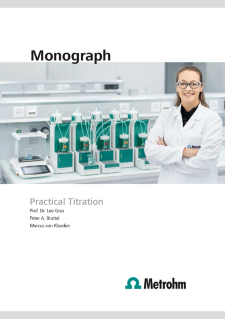
Pobierz bezpłatnie monografię (ang. wersja językowa)

Bezpłatna monografia „Practical titration” obejmuje teorię miareczkowania wyjaśniającą reakcje miareczkowania, metody oznaczania, elektrody i titranty. W części praktycznej omówiono miareczkowanie kwasowo-zasadowe, strąceniowee, redoks, kompleksometryczne i chelometryczne.