
In addition, we also offer pre-calibration models. Pre-calibrations are robust, ready-to-use operating procedures for certain applications based on real product spectra. They allow you to immediately start your NIR analysis without any time-consuming sample sourcing, sample preparation, or prediction model development needed. Pre-calibrations are available for quality control of isocyanates, polymers, polyols, fuels, wood pulps, palm oil, food and feed samples, cannabis testing, and more.

БИК спектроскопия
Спектрометры ближнего инфракрасного диапазона в качестве дополнительного метода для анализа широкого спектра образцов в лаборатории и на производстве, начиная от жидкостей, твердых веществ и паст до суспензий, таблеток и капсул.
БИК спектроскопия
ru
Спектрометры ближнего инфракрасного диапазона в качестве дополнительного метода для анализа широкого спектра образцов в лаборатории и на производстве, начиная от жидкостей, твердых веществ и паст до суспензий, таблеток и капсул.
Какими бы ни были Ваши требования — у нас есть подходящий БИК-спектрометр
Наш портфолио спектрометров ближнего инфракрасного диапазона включает лабораторные БИК-анализаторы для обеспечения гарантии и контроля качества, а также поточные БИК-анализаторы для онлайн-мониторинга химических параметров в различных отраслях промышленности. Воспользуйтесь фильтрами, чтобы уточнить поиск и найти подходящий Ваши задачам БИК-спектрометр. Если Вы ищете рамановские инструменты, перейдите к нашим Рамановским спектрометрам.
Почему БИК-спектрометр от Metrohm? – Это качетсво, которому можно доверять

С момента своего основания в 1943 году компания Metrohm превратилась в надежного поставщика стабильно высококачественных и надежных приборов для точного химического анализа.
- Получиайте все необходимое для БИК-спектроскопии от одного поставщика: от БИК-анализатора до предварительных калибровок и программного обеспечения для БИК-спектроскопии.
- Положитесь на ноу-хау от экспертов, собранных в более чем 130 прикладных докладах.
- Воспользуйтесь нашим глобальным присутствием в более чем 80 странах и получите местную поддержку со стороны наших экспертов по обслуживанию и применениям.
Узнайте больше о БИК-спектроскопии из рекомендаций по применению и вебинаров, проводимых нашими экспертами::
Спектрометры ближнего инфракрасного диапазона – FAQs
A near-infrared (NIR) spectrometer measures the interaction of light and matter (i.e., the sample) in the near-infrared region of the electromagnetic spectrum, i.e., in the wavelength range of 780 to 2500 nm.
The molecules in a sample absorb and reflect light differently, based on their chemical and physical structure. By measuring the intensity of light at different wavelengths, a NIR spectroscopy device can generate a spectral profile or fingerprint of a sample.
This profile can then be compared to reference spectra or analyzed using chemometric techniques to identify and quantify the components present in the sample. For instance, the spectral data can be used to quantify key quality parameters such as hydroxyl value, moisture, melt flow index, density, TAN, TBN, viscosity, protein and fat content, and fatty acid distribution. The data can also be used to identify or verify the identity of a sample.
Blog: Benefits of NIR spectroscopy

NIR spectroscopy is a secondary technique. Before starting any routine analysis, a prediction model is required. Prediction models are created using values from primary techniques or reference methods, such as titration.
- Use a primary technique to gather information about the sample, e.g., concentration or other parameters.
- With the NIR instrument, collect NIR spectra from samples with known concentrations or known parameter values. This set of spectra, known as a calibration set, is the basis to create prediction models. Part of the set of spectra is used as validation set to validate the prediction model. Prediction models can be created and validated using spectroscopy software, such as OMNIS Software.
- Once the prediction model has been created and validated, routine analysis can be started at the push of a button.
Metrohm can assist you with creating and validating prediciton models (step 1 and 2), making NIR spectroscopy even simpler and faster for you. Contact us to learn more.

Near-infrared spectroscopy is an analytical technique with numerous applications in various fields. Metrohm NIR analyzers can be used in the following industries:
- chemical
- polyol
- polymer
- food
- animal feed
- pharma
- personal care
- pulp and paper
- paint
- petrochemical
- petrofuel
The NIR instruments can be implemented in the laboratory as well as in the factory for at-line measurements. They are used for quality control and quality assurance, raw material identification, process and reaction monitoring, and screening, providing rapid and non-destructive analysis of samples.

NIR spectrometers analyze multiple parameters within one minute, without needing sample preparation or consumables. Modern NIR spectrometers, such as the OMNIS NIR Analyzer, include additional features that increase productivity:
- Flexibility: measure solid and liquid samples in highest accuracy
- Ease-of-use: create prediction models automatically by using the OMD (OMNIS Model Developer)
- Designed as a platform: fully automate your NIR measurements or combine it with titration
- Compliance: full compliance with FDA 21 CFR Part 11, USP<856> , EP, and JP regulations
- Adaptability: use the instrument as a standalone, or in a client/server environment
The advantages of NIR spectroscopy (NIRS) over IR spectroscopy are:
- The intensity of the bands are lower with NIRS. Thus, there is less detector saturation. This means that for solids you can use pure samples and for liquids the standard method is to use 8 mm vials.
- The energy of the light is higher with NIRS. This leads to deeper sample penetration. This means you can obtain information about the bulk of the sample and not just the surface.
- NIRS can be used for quantification and identification, wheras IR is almost exclusively used for identification.
- NIRS works with fiber optics, which means it can also be used directly in the process.
Learn more about the differences between NIRS and IR in our blog:

The OMNIS NIR Analyzer Liquid/Solid allows for both measurements of solid samples in reflection and measurements of liquid samples in transmission. The instrument can switch conveniently between both measurement modes and no changes in hardware are required. This means that users have a high degree of flexibility and they save time and costs.
The OMNIS platform makes automated and completely unattended NIR measurements possible with the OMNIS NIR Analyzer. There are two options, depending on the application and user preferences.
- The first option is automated measurements of up to more than 200 samples with closed vials for liquid or solid samples using the OMNIS Sample Robot NIR.
- The alternative for liquid samples is a flow-through cell set-up with an OMNIS Sample Robot, also allowing more than 200 samples to be processed and analyzed in series in an unattended manner.
Both options lead to NIR Analyzer setups with full walkaway capabilities.

The Metrohm OMNIS NIR Analyzer series are instruments for the measurement of solid and liquid samples in the area of food & feed as well as chemical, pharma, polymer, and personal care. For food & feed, the OMNIS NIR Analyzer is very suitable to measure moisture, protein, ash, fiber and fats. For edible oil, it can also determine the fatty acid spectrum, i.e. the distribution of the different saturated and unsaturated fatty acids, such as oleic (C18:1) and linoleoic (C18:2) acid.
A large selection of NIR pre-calibrations are availabe with the OMNIS NIR Analyzer. These pre-calibrations are based on numerous real product spectra which means you do not need to perform any sample analysis or model creation. You can use the Metrohm pre-calibrations directly and start using your OMNIS NIR Analyzer immediately. Just unpack and you are ready to be successful.
Metrohm NIR pre-calibrations are available for different products and applications in the areas of polymer, chemicals and food & feed. Examples include:
- PE
- PP
- PET
- PA6
- polyols
- isocyanaytes
- cannabis
- edible oil
- palm-oil
- coffee
- flour
- milk powder
The OMNIS Software includes algorithms such as PCA, PLS, and SVM, enabling users to develop models with high accuracy and robustness. Visualization of sample properties in score, loading, and influence plots simplifies method development and allows users to extract the maximum value from their data, all while maintaining an intuitive workflow.
Furthermore, the OMNIS Software allows the combination of multiple model types to further increase accuracy and expand application possibilities. For example, identification models can be structured into multiple sub-identification models to distinguish even more similar substances, while sub-quantification models can be built for specific concentration ranges to improve accuracy.
Creation of prediction models can be a challenging task for two reasons.
- It requires samples with known reference values for the training set, to serve as a basis for the model development. These samples should cover the expected range for the parameter of interest.
- In order to create a prediction model from these samples, a technique called chemometrics, or multivariate data analysis, needs to be applied. This usually requires that the user has knowledge of chemometrics.
With the OMNIS NIR Analyzer series, everybody can develop prediction models with the OMD (OMNIS Model Developer) and no knowledge of chemometrics is required. The OMD is started with one click in the software and it creates prediction models automatically and without any further user interaction. These models can be saved and immediately used for routine measurements. When more samples have been measured, these models can also be easily updated at a later stage.
Что делает спектрометр ближнего инфракрасного диапазона?
Спектрометр ближнего инфракрасного диапазона (БИК) измеряет взаимодействие света и вещества (т.е. образца) в ближней инфракрасной области электромагнитного спектра, т.е. в диапазоне длин волн от 780 до 2500 нм.
Молекулы в образце по-разному поглощают и отражают свет в зависимости от их химической и физической структуры. Измеряя интенсивность света на разных длинах волн, оборудование БИК-спектроскопии может генерировать спектральный профиль или отпечаток образца.
Затем этот профиль можно сравнить с эталонными спектрами или проанализировать с использованием хемометрических методов для идентификации и количественного определения компонентов, присутствующих в образце. Например, спектральные данные можно использовать для количественной оценки ключевых параметров качества, таких как гидроксильное число, влажность, индекс текучести расплава, плотность, кислотное и основное число и вязкость. Данные также можно использовать для идентификации или проверки подлинности образца.
Блог: Преимущества БИК-спектроскопии
Как выполнятеся анализ в БИК-спектроскопии?

БИК-спектроскопия является вторичным методом. Прежде чем приступить к любому рутинному анализу, необходима модель прогнозирования. Модели прогнозирования создаются с использованием значений первичных или эталонных методов, таких как титрование.
- Используйте первичный метод для сбора информации об образце, например, концентрации или других параметрах.
- С помощью спектрометра БИК соберите спектры образцов с известными концентрациями или известными значениями параметров. Этот набор спектров, известный как калибровочный набор, является основой для создания моделей прогнозирования. Часть набора спектров используют в качестве набора валидации для проверки модели прогнозирования. Модели прогнозирования можно создавать и проверять с помощью программного обеспечения для спектроскопии, такого как Metrohm Vision Air Complete.
- После создания и проверки модели прогнозирования рутинный анализ можно запустить одним нажатием кнопки.
Metrohm может помочь Вам создать и проверить модели прогнозирования (шаги 1 и 2), что сделает NIR-спектроскопию еще проще и быстрее. Свяжитесь с нами чтобы узнать больше.
Кроме того, мы предлагаем для предустановленные калибровочные модели. Пре-калибровка - это надежные, готовые к использованию рабочие процедуры для определенных областей применения, основанные на реальных спектрах. Они позволяют вам немедленно приступить к БИК анализу без необходимости в поиске образцов, их подготовке или разработке модели прогнозирования. Доступны пре-калибровки для тестирования каннабиса, контроля качества изоцианатов, полимеров, полиолов, топлива, древесной массы, пальмового масла и человеческих фекалий.
Кроме того, мы также предлагаем модели с предварительной калибровкой. Предварительная калибровка — это надежные, готовые к использованию рабочие процедуры для определенных применений, основанные на реальных спектрах продуктов. Они позволяют Вам сразу же начать анализ БИК без необходимости трудоемкого поиска образцов, их подготовки и разработки модели прогнозирования. Доступны предварительные калибровки для тестирования контроля качества изоцианатов, полимеров, полиолов, топлива, древесной массы, пальмового масла и человеческих фекалий.
Какие анализы можно выполнять с помощью БИК-спектрометров Metrohm?

Спектроскопия ближнего инфракрасного диапазона — аналитический метод, имеющий многочисленные применения в различных областях. БИК-анализаторы Metrohm возможно применять в химической, полиоловой, полимерной, пищевой, кормовой, фармацевтической, целлюлозно-бумажной, лакокрасочной, нефтехимической и нефтетопливной промышленности. Анализаторы БИК можно использовать как в лаборатории, так и на заводе для проведения измерений в режиме реального времени. Их используют для контроля и обеспечения качества, идентификации сырья, мониторинга процессов и реакций, а также скрининга, обеспечивая быстрый и неразрушающий анализ проб.
Узнайте больше о применениях БИК-спектроскопии из наших прикладных работ
БИК-спектроскопия: повышение эффективности лабораторий контроля качества
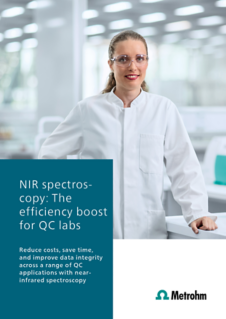
Эта электронная книга представляет собой всестороннее введение в тему быстрого контроля качества с использованием спектроскопии ближнего инфракрасного диапазона (БИК). В электронной книге представлена основная информация о технологии и ее реализации, а также конкретные примеры применения из различных отраслей промышленности (химической, фармацевтической, полимерной, нефтеперерабатывающей).